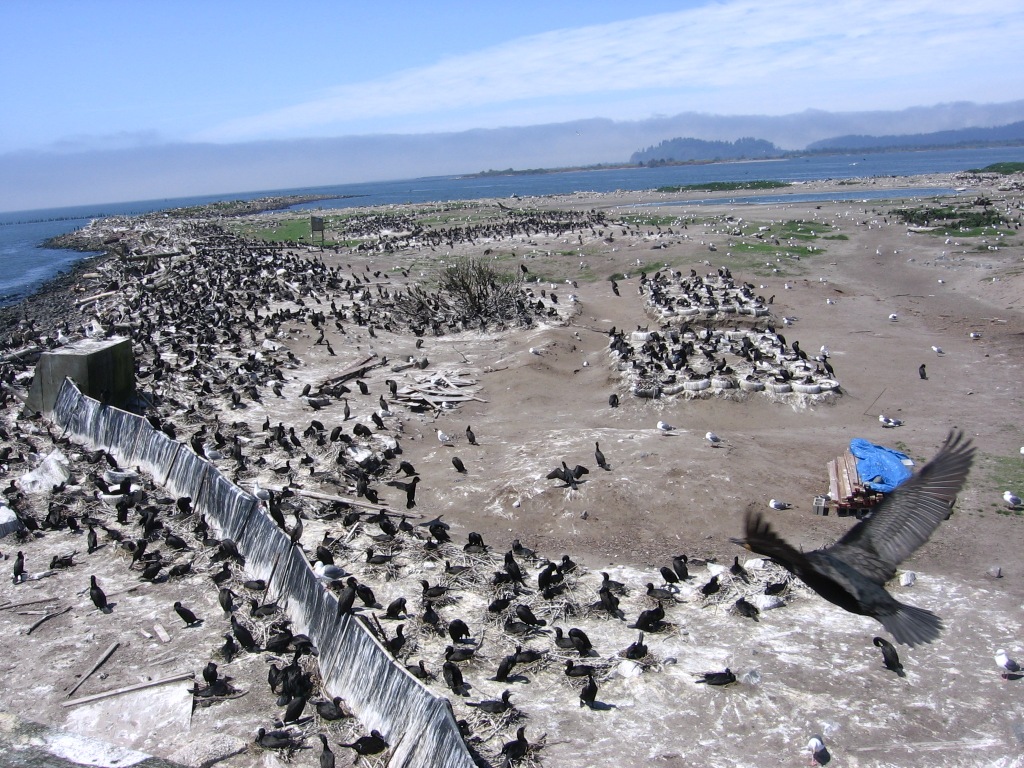
We study the interactions between piscivorous colonial waterbirds and fish populations across the Columbia Basin and the Pacific Coast.
Our research provides the scientific foundation for management initiatives that balance waterbird conservation with the recovery of threatened and endangered salmon and steelhead.
We focus on understanding species such as Caspian terns, double-crested cormorants, American white pelicans, and several gull species, conducting field studies, monitoring, and data analysis to inform effective, science-based management.
Our Focus
Colony Monitoring
We track the size, distribution, and productivity of waterbird colonies in Oregon, Washington, and California.
Diet and Foraging
By analyzing diet composition and foraging behavior, we assess the impacts of avian predation on juvenile salmonids and other fishes of conservation concern.
Management Evaluation
We evaluate the effectiveness of regional management initiatives, including the Caspian Tern Management Plan for the Columbia River Estuary, Double-crested Cormorant Management Plan for the Columbia River Estuary, and the Inland Avian Predation Management Plan Environmental Assessment.
Collaborative Conservation Science
We work closely with agencies, universities, and conservation organizations to support strategies that maintain healthy bird populations while protecting fisheries resources.
Our Collaborative Partnerships
This research project is a joint effort between:
- Oregon State University
- Real Time Research, Inc.
- U.S. Geological Survey
Support for our research comes or has come from:
- Bonneville Power Administration
- Columbia River Inter-Tribal Fish Commission
- Confederated Tribes of the Warm Springs
- Confederated Tribes and Bands of the Yakama Nation
- Grant County Public Utility District via the Priest Rapids Coordinating Committee
- NOAA Fisheries
- Pacific Salmon Commission
- U.S. Army Corps of Engineers – Walla Walla District
- U.S. Army Corps of Engineers – Portland District
- U.S. Bureau of Reclamation
- U.S. Fish and Wildlife Service
Our Cooperators
We are proud to collaborate with a wide range of organizations and agencies, including:
Audubon Society of Portland
Big Sur Ornithology Lab
Bonneville Power Administration
Bureau of Reclamation
California Department of Fish and Game
California Maritime Academy
Cargill Salt Company
Chelan County Public Utility District
Clallam County Parks
Columbia River Inter-Tribal Fish Commission
Department of Fisheries and Wildlife, Oregon State University
Don Edwards San Francisco Bay National Wildlife Refuge
Dungeness National Wildlife Refuge
East Bay Regional Park District
Fern Ridge Wildlife Area, ODFW
Forest and Rangeland Ecosystem Science Center, USGS
Grant County Public Utility District
Hart Mountain National Antelope Refuge
Humboldt State University
Idaho Department of Fish and Game
Lower Klamath National Wildlife Refuge
Malheur National Wildlife Refuge
Marine Science Institute
McNary National Wildlife Refuge
National Park Service
NOAA Fisheries
Northwest Power and Conservation Council
Oregon Department of Fish and Wildlife
Oregon Division of State Lands
Oregon Maritime National Wildlife Refuge Complex
Pacific Northwest National Laboratory
Pacific States Marine Fisheries Commission
Point Reyes Bird Observatory Conservation Science
Potholes Game Reserve
San Francisco Bay Bird Observatory
San Francisco Bay Estuary Field Station, USGS
San Pablo Bay National Wildlife Refuge
Seabird Restoration Program, National Audubon Society
Summer Lake Wildlife Area, ODFW
Tule Lake National Wildlife Refuge
University of California, Davis
U.S. Army Corps of Engineers
U.S. Department of Agriculture – Wildlife Services
U.S. Department of Agriculture – National Wildlife Research Center, Mississippi State
U.S. Fish and Wildlife Service
U.S. Geological Survey
Washington Department of Fish and Wildlife
Washington Maritime National Wildlife Refuge Complex
Willamette University
Our Impact
Through long-term monitoring, applied research, and collaborative partnerships helps guide science-based management of waterbirds and fish, providing data that informs conservation strategies, protects threatened species, and ensures balanced ecosystems across the Pacific Coast.